
關於BASIC CHEMISTRY - OFFLINE
Explore Essential Chemistry Concepts with BASIC CHEMISTRY - OFFLINE
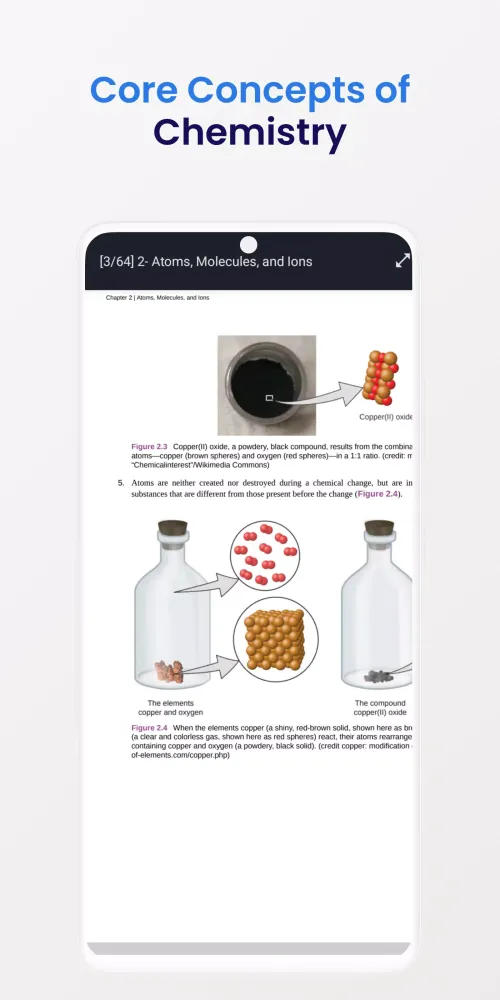
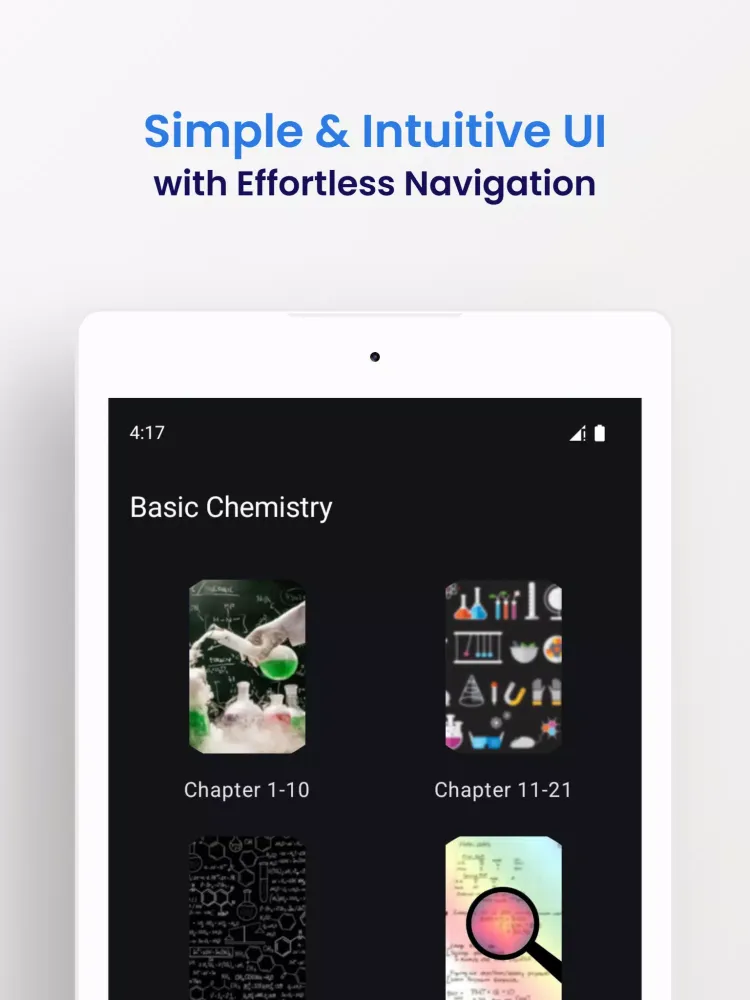
Welcome to BASIC CHEMISTRY - KNOWLEDGE ON THE GO, a comprehensive offline application designed to help you master fundamental chemistry concepts. Whether you're a student, a lifelong learner, or someone aiming to enhance their knowledge, this app is tailored for all levels of understanding. The content is based on OpenStax's educational resources, ensuring quality and accuracy.
Key Features
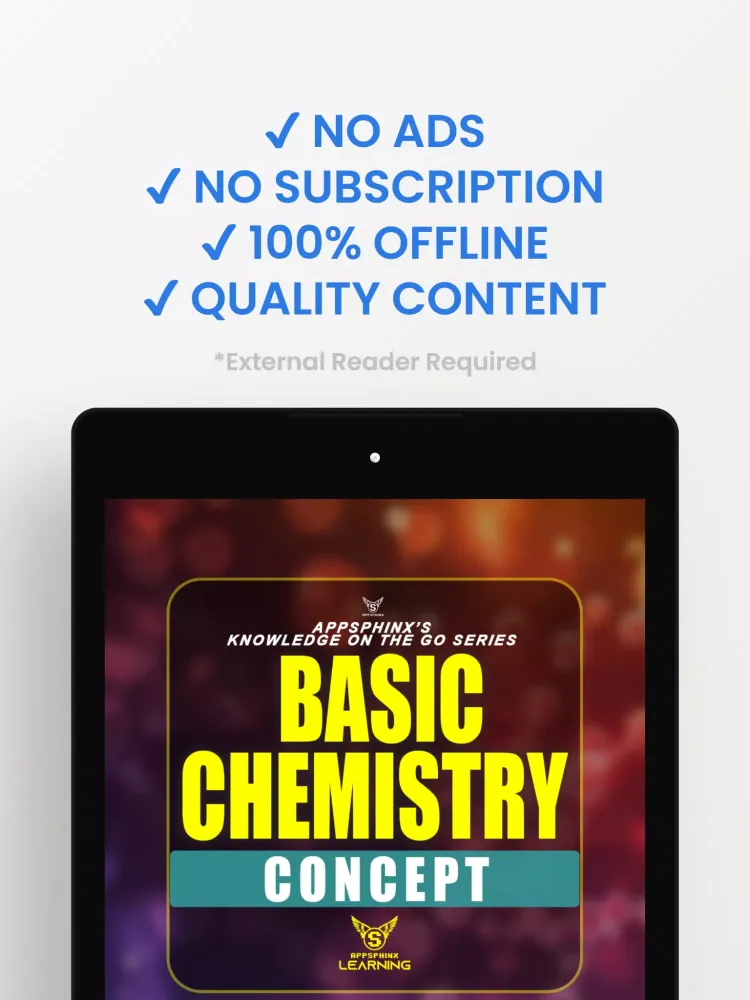
- NO ADS: Enjoy a distraction-free learning experience.
- NO SUBSCRIPTION: Access everything without any recurring fees.
- 100% OFFLINE: Study anytime, anywhere, even without internet access.
- QUALITY CONTENT: Comprehensive and well-organized study materials.
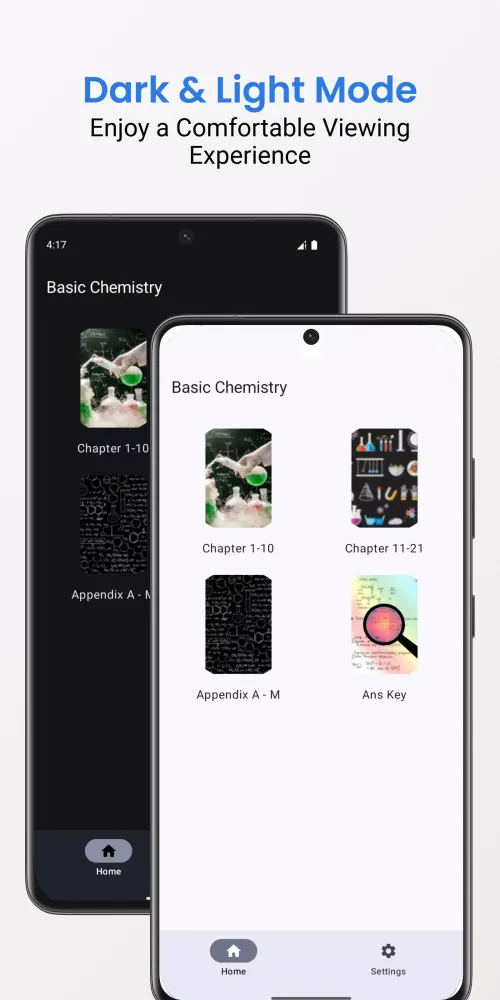
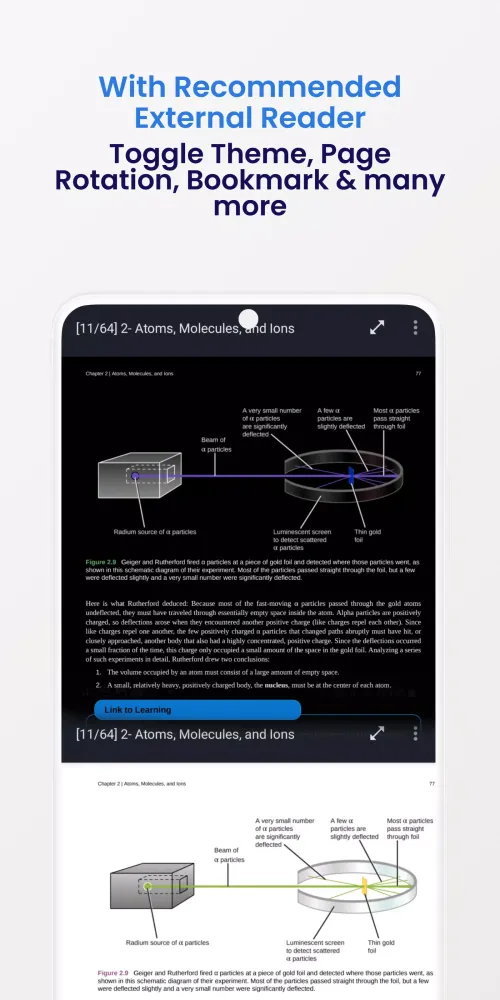
- TOGGLE THEME: Customize your reading experience with different themes (via external reader app).
Who Can Benefit?
This app is suitable for not only school and college students but also for those preparing for competitive exams such as UPSC CSE, SSC CGL, IBPS - Bank PO, CAT, OPSC, and ASO aspirants. It's perfect for anyone looking to solidify their basic chemistry knowledge.
Current Note:
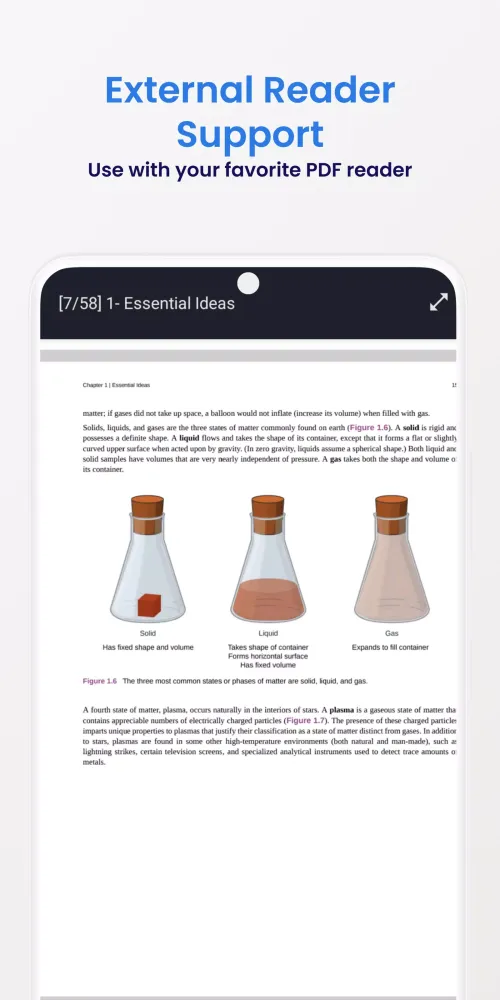
We have removed the in-app reader due to maintenance challenges. We are currently developing our in-house PDF reader, Appsphinx PDF Reader. In the meantime, we recommend using a third-party PDF reader. You can find a recommended open-source PDF reader in the settings page of the app to enhance your experience.
Detailed App Content
The app covers a wide range of topics from basic chemistry principles to advanced theories:
-
Essential Ideas
- Chemistry in Context
- Phases and Classification of Matter
- Physical and Chemical Properties
- Measurements
- Measurement Uncertainty, Accuracy, and Precision
- Mathematical Treatment of Measurement Results
-
Atoms, Molecules, and Ions
- Early Ideas in Atomic Theory
- Evolution of Atomic Theory
- Atomic Structure and Symbolism
- Chemical Formulas
- The Periodic Table
- Molecular and Ionic Compounds
- Chemical Nomenclature
-
Composition of Substances and Solutions
- Formula Mass and the Mole Concept
- Determining Empirical and Molecular Formulas
- Molarity
- Other Units for Solution Concentrations
-
Stoichiometry of Chemical Reactions
- Writing and Balancing Chemical Equations
- Classifying Chemical Reactions
- Reaction Stoichiometry
- Reaction Yields
- Quantitative Chemical Analysis
-
Thermochemistry
- Energy Basics
- Calorimetry
- Enthalpy
-
Electronic Structure and Periodic Properties of Elements
- Electromagnetic Energy
- The Bohr Model
- Development of Quantum Theory
- Electronic Structure of Atoms (Electron Configurations)
- Periodic Variations in Element Properties
-
Chemical Bonding and Molecular Geometry
- Ionic Bonding
- Covalent Bonding
- Lewis Symbols and Structures
- Formal Charges and Resonance
- Strengths of Ionic and Covalent Bonds
- Molecular Structure and Polarity
-
Advanced Theories of Covalent Bonding
- Valence Bond Theory
- Hybrid Atomic Orbitals
- Molecular Orbital Theory
-
Gases
- Gas Pressure
- Relating Pressure, Volume, Amount, and Temperature: The Ideal Gas Law
- Effusion and Diffusion of Gases
- The Kinetic-Molecular Theory
- Non-Ideal Gas Behavior
-
Liquids and Solids
- The Solid State of Matter
- Lattice Structures in Crystalline Solids
-
Solutions and Colloids
- The Dissolution Process
- Colligative Properties
- Colloids
-
Kinetics
- Chemical Reaction Rates
- Factors Affecting Reaction Rates
- Rate Laws
- Integrated Rate Laws
- Catalysis
-
Fundamental Equilibrium Concepts
- Chemical Equilibria
- Equilibrium Constants
- Shifting Equilibria: Le Châtelier’s Principle
- Equilibrium Calculations
-
Acid-Base Equilibria
- Acids and Bases
- pH and pOH
- Relative Strengths of Acids and Bases
- Acid-Base Titrations
-
Equilibria of Other Reaction Classes
- Precipitation and Dissolution
- Lewis Acids and Bases
- Coupled Equilibria
-
Thermodynamics
- Entropy
- The Second and Third Laws of Thermodynamics
- Free Energy
-
Electrochemistry
- Review of Redox Chemistry
- Galvanic Cells
- Electrode and Cell Potentials
- Potential, Free Energy, and Equilibrium
- Batteries and Fuel Cells
Start exploring these topics today and elevate your understanding of chemistry!
BASIC CHEMISTRY - OFFLINE應用截圖
BASIC CHEMISTRY - OFFLINE的歷史版本



編輯推薦


類似BASIC CHEMISTRY - OFFLINE的應用程式


Appsphinx Learning的應用程式
用戶評論
+ 評論
最受歡迎


