
Dream League Soccer 2026 Review: Building a Club Is as Important as Winning Matches


Dream League Soccer 2026 is easy to describe as a mobile football game, but that misses half of what keeps it moving. You control the players on the pitch, then return to a club screen where recruitment, training, facilities, stadium capacity, and currencies shape the next match.
That combination is the game's identity. A good run of results is satisfying, yet progress is not based on match skill alone. The squad you build, the upgrades you prioritize, and the way you respond to its free-to-play economy matter just as much.
APKHub still displays the older Dream League Soccer 2024 name for package com.firsttouchgames.dls7. The current official Google Play title is Dream League Soccer 2026, so this review uses the current name and avoids tying the verdict to one temporary event or seasonal offer.
The Main Loop Connects Football and Club Building
The basic cycle is clear: play matches, earn resources, improve the team, expand the club, and face stronger competition. The official listing describes eight divisions and more than ten cup competitions, giving the solo structure a visible ladder rather than a loose collection of exhibition matches.
Recruitment is built around a pool of more than 4,000 FIFPRO-licensed players. Agents and Scouts help surface new signings, while Coaches develop the players already in the squad. Stadium and facility upgrades expand the management side, including medical, commercial, and training infrastructure.
The loop works because every layer feeds another. A stronger squad can make promotion more realistic. Better facilities can support player development. Stadium investment becomes part of advancement rather than a cosmetic side project. The risk is that several upgrade tracks compete for the same limited attention and resources.
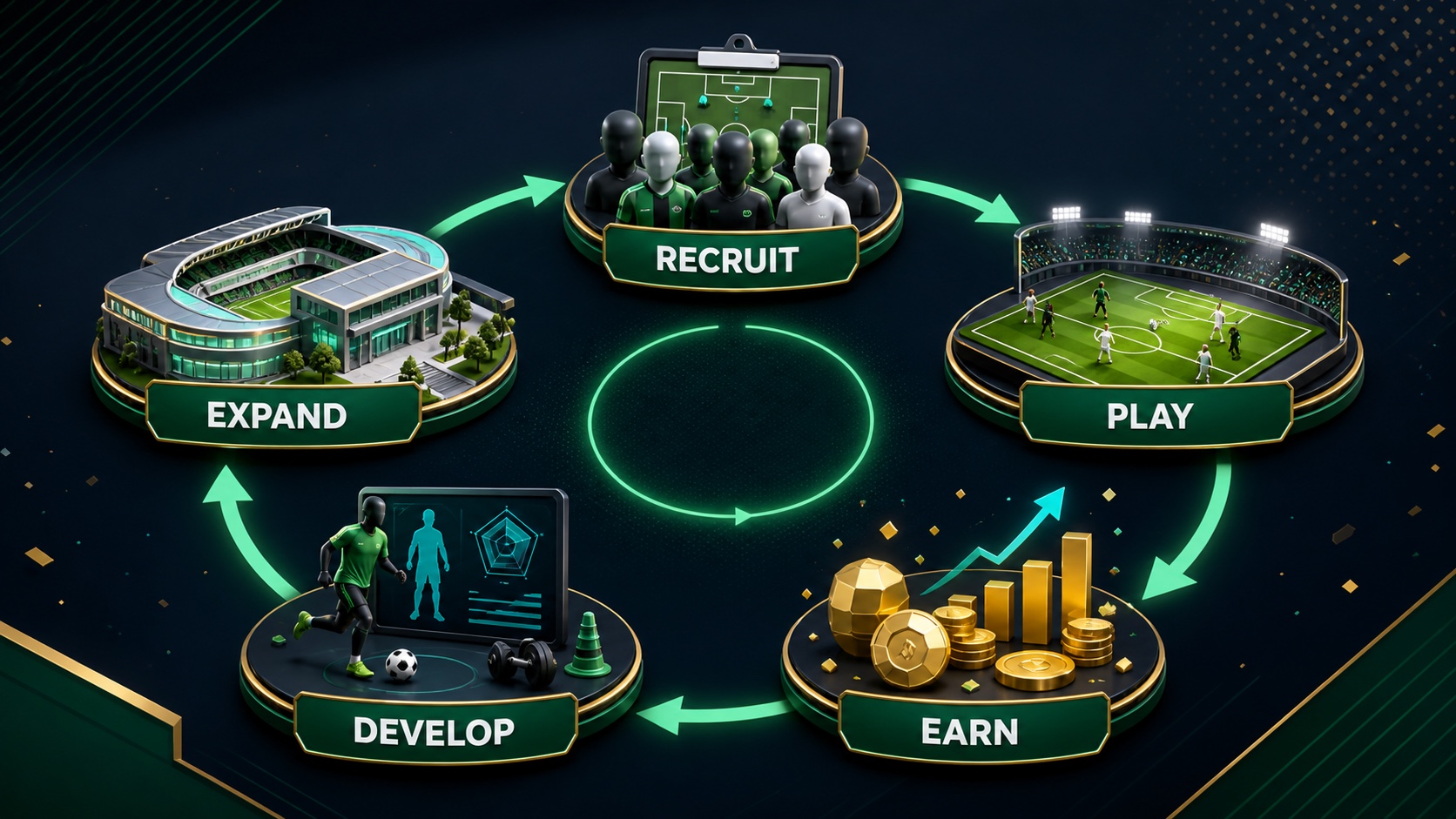
Editorial illustration: Dream League Soccer moves between football matches and a broader club-development loop.
On-Pitch Play Is Accessible, but It Still Demands Timing
Dream League Soccer uses a compact mobile control scheme rather than trying to reproduce every command from a console simulation. Passing, shooting, crossing, tackling, player switching, movement, and set pieces are organized around a small set of touch controls.
That simplicity helps a new player complete a match quickly. It does not remove the need to read space. Passing too early can isolate the next receiver, holding the ball too long invites pressure, and aggressive defending can pull the back line out of shape. The better habit is to think one action ahead instead of pressing the fastest available button.
The official description highlights motion-captured kicks, tackles, celebrations, and goalkeeper saves, along with new animations and improved AI. Those statements describe the intended presentation, not a promise that every device or every match will feel identical. Responsiveness can still depend on hardware, connection quality, updates, and the situation on the pitch.
Players looking for a highly technical simulation may find the control model simplified. Players who want short, readable football matches with enough tactical choice to reward practice are more likely to appreciate it.
A Famous Name Is Not the Same as a Balanced Team
Collecting recognizable players is a major attraction, but filling every position with the highest available rating is not a complete plan. A useful squad also needs pace in the right areas, enough defensive coverage, reliable passing options, substitutes, and a formation that matches how you actually play.
Coaches create another decision. Improving a current starter can be more valuable than repeatedly waiting for a glamorous transfer. Stadium and facility spending can also compete with the transfer market, forcing the player to decide whether the next upgrade should help one position or the entire club.
This is where Dream League Soccer becomes more interesting than a sequence of matches. The club screen asks whether short-term power is worth delaying infrastructure. The transfer market asks whether a famous attacker solves the team's real weakness. There is rarely one universally correct answer because the value depends on the current squad and division.
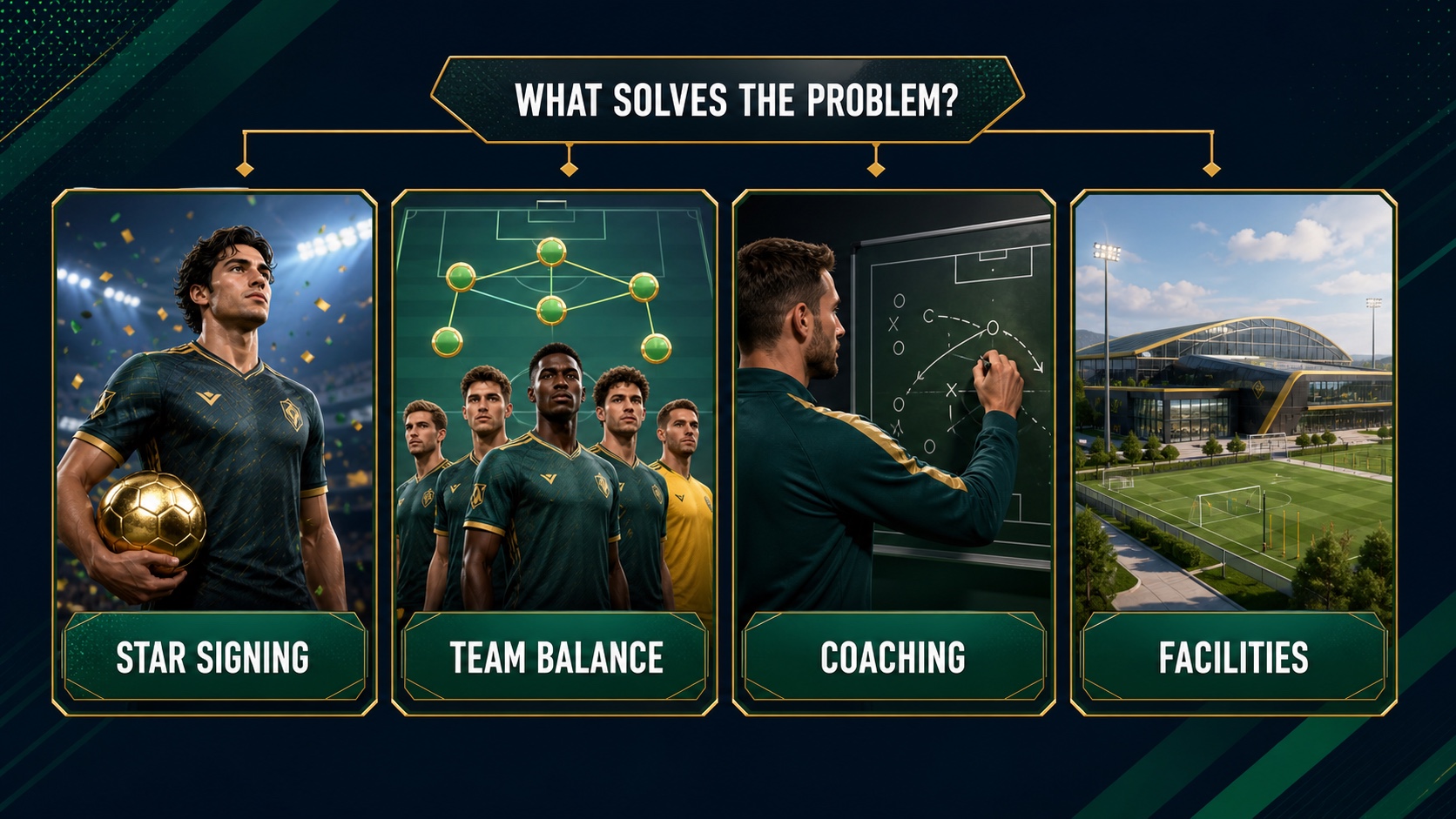
Editorial illustration: the best next upgrade may be a balanced starter, a Coach, or a facility rather than the biggest available name.
Solo Progression, Live Competition, Clans, and Short Challenges
The game provides several reasons to play beyond the next league fixture. Dream League Live is the competitive online route, with global rankings and events. Daily scenarios offer a shorter challenge, while Dream Draft changes the usual squad-building rhythm. The current version also includes a Clan system built around shared goals and rewards.
These modes serve different players. Divisions and cups provide a more predictable solo climb. Live play introduces human decisions and network conditions. Clans add a social layer. Daily scenarios and Draft are better suited to a shorter session or a temporary change of rules.
The variety is welcome, but it also makes the interface and reward structure busier. New players do not need to chase every tab immediately. Learning the match controls, stabilizing the first team, and understanding the upgrade economy is a better starting order than trying to optimize every event at once.
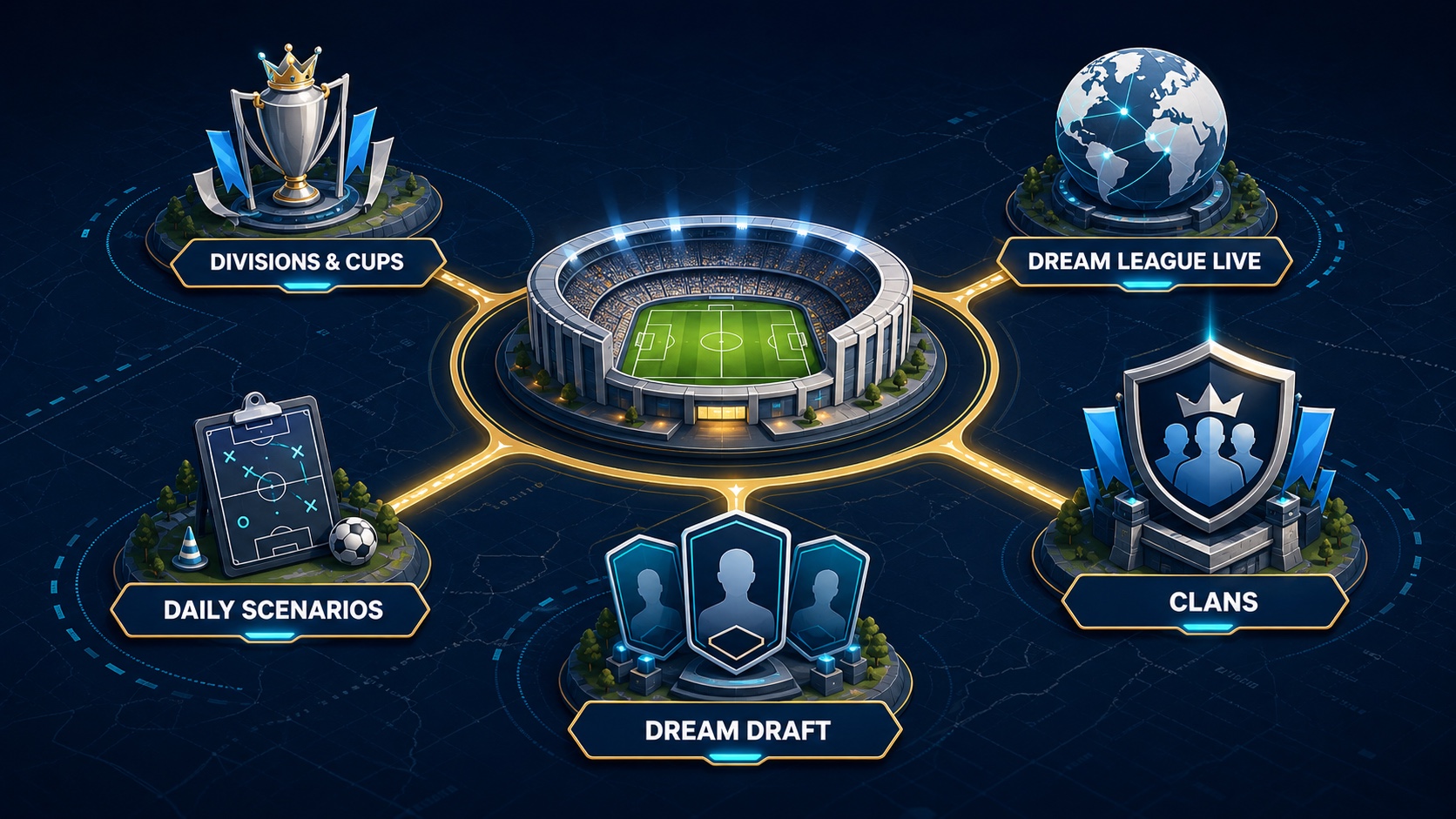
Editorial illustration: each mode has a different rhythm, from steady solo progression to online competition and short challenges.
Free-to-Play Convenience Comes with Several Pressure Points
Dream League Soccer 2026 is free to download, but Google Play labels it as containing ads, in-app purchases, and random-item purchases. The official description also says some content and in-game items can be bought with real money.
That does not mean spending is required for every useful session. It does mean the progression loop is designed around currencies, offers, rewards, and upgrade friction. Players who enjoy gradual team building may accept that pace. Someone who wants a complete premium football game with no commercial prompts may find the structure distracting.
A practical approach is to set a budget before opening the store, not after an appealing offer appears. Treat randomized items as uncertain outcomes, never as a guaranteed route to one desired player. For a child or shared device, Play Store purchase authentication should be enabled before play begins.
The developer also states that an internet connection is required and that the game contains third-party advertising. Google Play can attach an Offline discovery tag in some regions, but the developer's explicit network requirement is the safer expectation. Do not install it as an offline-only travel game.
Privacy and Account Settings Deserve a Quick Review
Google Play's developer-provided data-safety section says the game may share location, financial information, and other data categories with third parties. It may collect location, personal information, and additional categories. The listing says data is encrypted in transit and that users can request deletion.
Those declarations are a summary supplied by the developer, not a complete map of every data flow. Actual processing can vary with region, age, account state, advertising, purchases, and the permissions granted on the device.
Review purchase authentication, ad choices where available, account links, notifications, and device permissions. If the game is used by a child, check both the game settings and the wider Google Play family controls rather than relying on one in-game toggle.
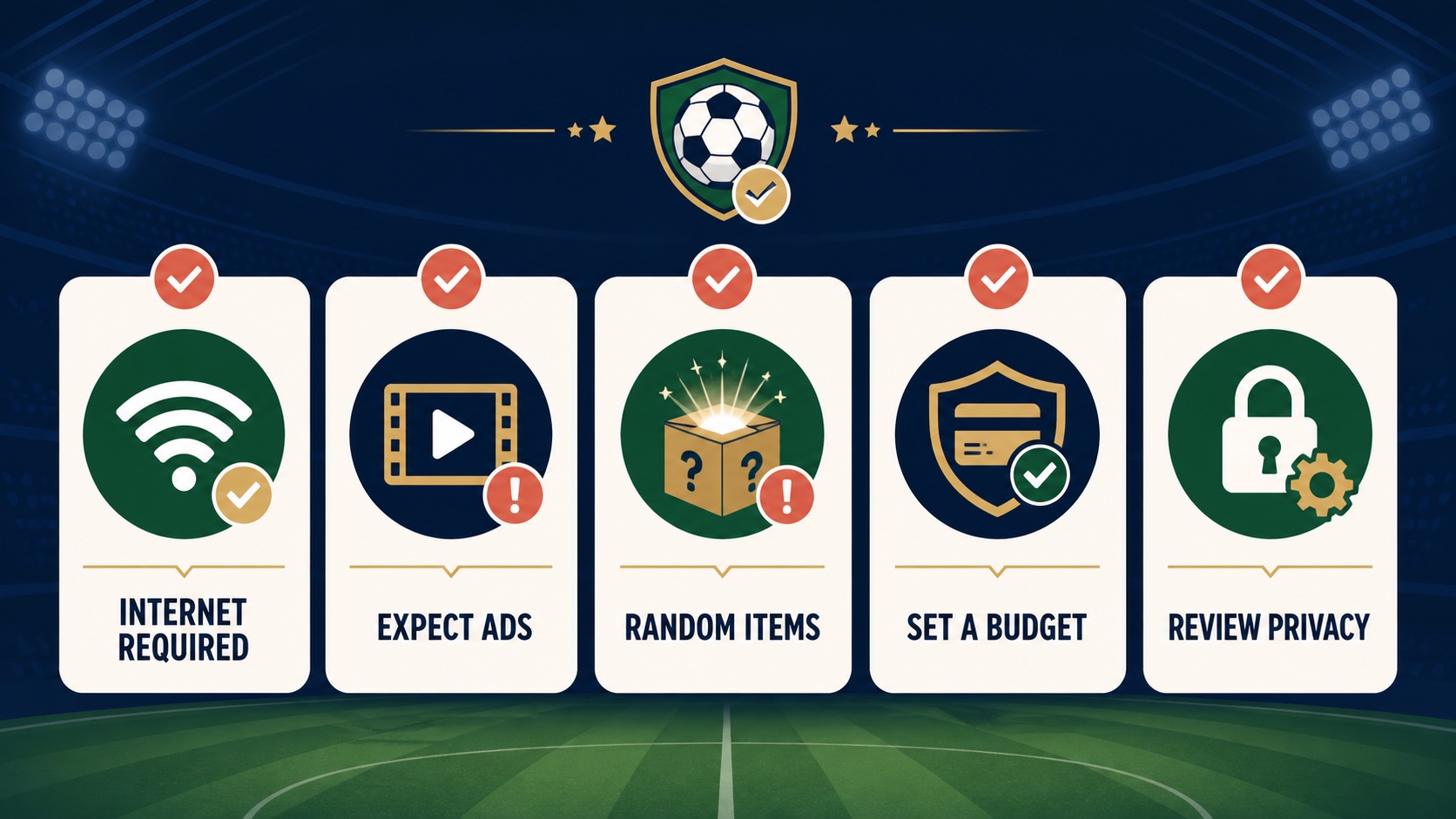
Editorial illustration: a sensible setup includes network expectations, a spending limit, purchase authentication, and a permissions review.
What Dream League Soccer 2026 Does Well
- It links playable football matches to a clear club-development loop.
- The official 4,000-plus-player pool gives recruitment meaningful variety.
- Divisions, cups, Live play, Clans, scenarios, and Draft support different session types.
- Stadium and facility investment makes progression broader than player ratings alone.
- The touch controls are approachable enough for short mobile sessions.
Where It Can Frustrate
- Multiple currencies and upgrade tracks can make the early game feel crowded.
- Ads, purchases, and randomized items sit inside the core progression environment.
- An internet connection is required, limiting truly offline use.
- Live competition adds network and matchmaking variables that solo play does not have.
- The simplified control model will not satisfy everyone looking for a deep simulation.
Who Should Play It?
Dream League Soccer 2026 is a good fit for players who want direct control during matches but also enjoy assembling a squad and improving a club over time. It works especially well for someone who prefers a visible promotion ladder and does not mind returning to management screens between fixtures.
It is a weaker fit for players who want a one-time premium purchase, guaranteed access to a specific star, offline play, or a football simulation built around complex manual commands. The free-to-play structure is part of the game, not a separate menu that can be ignored completely.
Final Verdict
Dream League Soccer 2026 succeeds because its matches and management systems support the same fantasy: starting with an ordinary club and building something stronger.
The football is accessible, the progression has clear milestones, and the player pool makes recruitment exciting. The trade-off is a busy economy where ads, currencies, facility costs, and random-item purchases can compete with the pleasure of simply playing.
Approach it as a long-term club project rather than a fast collection race. Build a balanced team, invest in the parts of the club that solve current problems, and decide on spending limits before the next offer appears. With those expectations, it is one of the more complete football-management hybrids available on Android.


.webp?x-oss-process=image/resize,w_80/format,webp)