
Duet Review — Keep Both Sides of the Circle in View

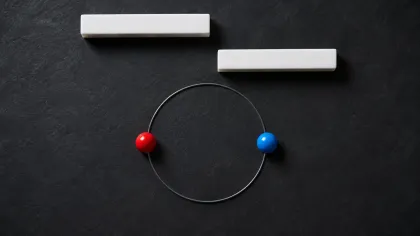

Duet gives you two colored spheres moving around one shared circle. Rotating them to avoid an obstacle sounds modest until saving one sphere brings the other into trouble. The game turns that fixed relationship into a demanding exercise in attention, with simple shapes doing nearly all of the work.
One movement has two consequences
The red sphere and the blue sphere remain opposite each other. A safe opening on one side therefore needs to be considered alongside the space on the other. Watching just the sphere nearest an obstacle can make a sensible-looking correction fail elsewhere. The central task is learning to see the pair as one moving shape.

The gap gives an angle to aim for
A falling bar asks you to arrive at a useful orientation when it reaches the circle. Once that relationship becomes familiar, the pattern feels more readable. You can start rotating toward a position before the bar is immediately threatening. The timing still matters, but the obstacle begins to look like a question you understand.

The next obstacle changes the value of a safe position
Getting past one bar is easier when you also know where the following bar will leave room. An orientation that solves the immediate problem can require a large correction a moment later. Duet becomes especially satisfying when several small movements connect and the pair seems to flow through a sequence.

The restraint in the presentation helps. Clear silhouettes leave little doubt about what you hit, making another attempt a chance to revise a specific movement.
Music gives repetition a recognizable mood
Tim Shiel's soundtrack is a substantial part of the developer's description and of the game's identity. It gives the repeated attempts continuity while the patterns keep demanding your attention. The combination can be absorbing, though players who dislike revisiting a short sequence after a mistake may find the rhythm difficult to enjoy.

Duet suits players who like learning a compact rule deeply. Its best moments come when both sides of the circle stay in your awareness and a sequence that looked crowded suddenly becomes clear.


